042 When your client's suffering feels like your failure
Aug 05, 2026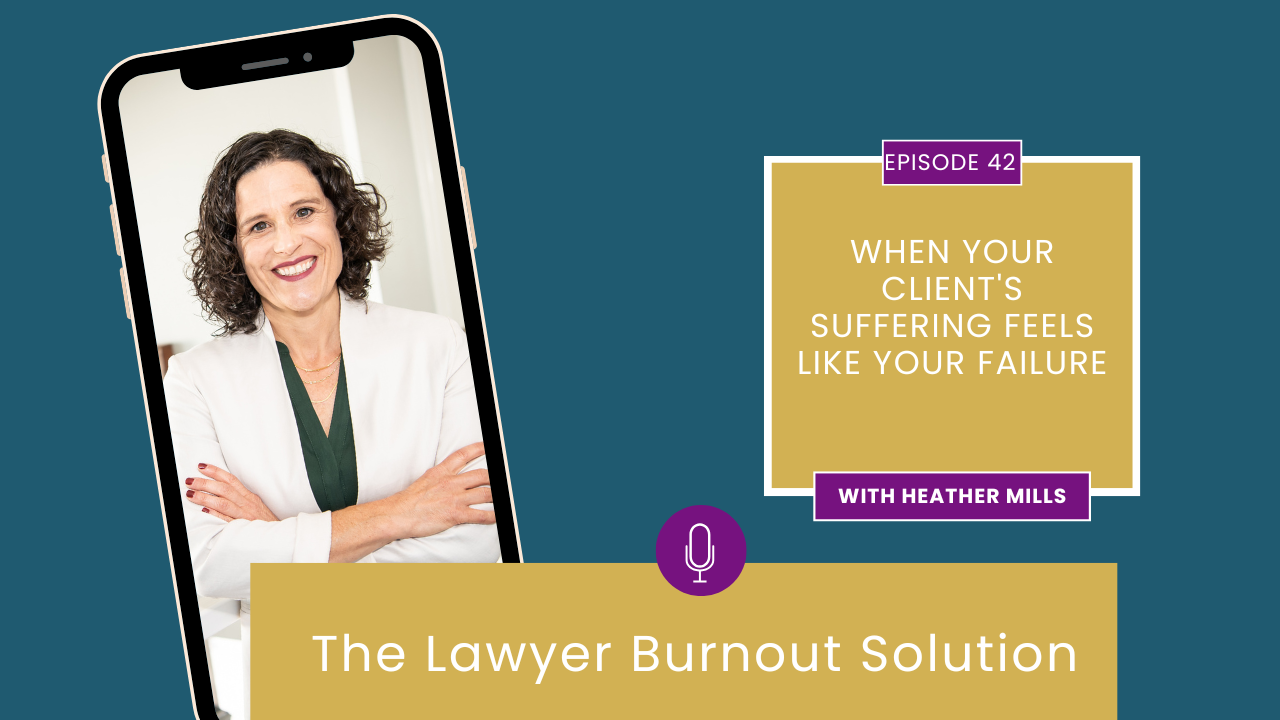
Why attorneys feel responsible for their client's emotions
You already know how to advocate well. You've never been taught where your responsibility actually ends.
When your client is suffering during the legal process, some part of you takes it on as proof you failed them. Even a win doesn't relieve it.
Legal training teaches you to anticipate harm and prevent bad outcomes, and somewhere in that training the standard silently expands: if your client suffers, you must have done something wrong. The belief assumes you're responsible not just for your advocacy, but for your client's suffering too.
Why does winning a case sometimes still feel like a loss?
This episode opens with something an attorney once said: even after winning the case, her client still went through hell to get there. That single sentence names a belief many attorneys carry without ever saying it out loud: that if you're doing your job well, you should be able to prevent your client's suffering.
Where does the belief that you should prevent your client's suffering come from?
We're socialized in so many ways to feel responsible for other people's emotions. One place many of us built this belief is in law school, where we were trained on the idea that a lawyer's job is to anticipate risk and prevent harm.
What actually changes once you separate your advocacy from your client's negative emotions?
The episode closes with this distinction: you're responsible for the quality of your advocacy, not whether the people you represent experience negative emotions along the way.
When you accept this, it doesn't mean you stop caring about your client. You end up suffering less. And you end up practicing law in a way that's more sustainable.
Summary
Attorneys are trained to prevent harm, and that training quietly becomes a belief that any suffering a client experiences reflects a failure of advocacy. It doesn't. Advocacy and another person's internal experience aren't the same thing, and no lawyer, however skilled, controls both.
Resources for women in law
Book a confidential 20-minute call at heathermillscoaching.com/call. We'll talk about what's driving your pattern and whether working together makes sense. Real conversation.
Follow on LinkedIn for weekly analysis of the patterns that keep high-performing attorneys stuck, and what actually changes them.
Even if we win the legal case, the client goes through hell in the process.” That’s what one of my clients told me as she listed off all the reasons for why she didn’t know if she could continue doing this work.
Welcome to The Lawyer Burnout Solution, for women attorneys who are still performing at a high level and want to understand what’s driving the internal pressure that won’t turn off. I’m Heather Mills.
Today we’re talking about a belief a lot of you carry without ever naming it: if you’re good enough, you should be able to prevent your client’s suffering. Where that belief comes from, why it doesn’t hold up, and what happens when you finally set it down.
From the first days in law school, lawyers are trained to anticipate what kind of harm their clients could suffer, to identify risks, and prevent bad outcomes before they happen. That’s excellent training.
But it implicitly teaches lawyers something else too: if my client suffers, I didn’t do a good enough job.
No one has ever said this explicitly, but that’s the interpretation we make. And so when the client suffers, and inevitably they do, because they’re human, the lawyer blames herself.
And if you're extremely diligent and conscientious in your work, the possibility that your client will suffer in ways you can't prevent is sometimes paralyzing.
I still remember learning in law school, in the training around contracts: anticipate every potential problem that could happen and try to prevent it through your contract clauses. At least that was my 25-year-old interpretation at the time. My reaction was that I couldn’t possibly anticipate everything bad that could happen. I would inevitably miss something. And I really didn’t want to feel that guilt and shame that would come when I missed something. So I told myself I shouldn’t go into that type of law.
When I look back now on that 25-year-old interpretation, I can see what my brain was trying to do. It was trying to protect me from ever feeling guilt or shame.
I had this belief that if I chose my career well, I could prevent myself from experiencing the normal negative emotions that come with life and work. Not consciously. I didn’t think I’d be happy all the time. But somewhere underneath, I believed the right choice would be a kind of protection.
I don’t think this is specific to me, or specific to legal careers. There’s this general idea that you’ll be happier if you just pick the right career.
And then within law, the belief gets more specific. You might think you’ll be spared if you pick the right area of law, the right kind of client.
But that belief only works if none of your clients actually suffer. Look at who that would have to include:
Whether you’re representing immigrants, or survivors of sexual assault, or people going through a divorce, or people accused of crimes, or business owners embroiled in a dispute... clients are going to suffer. They’re going to experience the full range of negative emotion.
Not because the legal system is brutal. Because being human is.
I remember learning, as a coach, the idea that life is 50/50. 50% of the time you can expect to experience negative thoughts and emotions. And 50% of the time, positive ones.
At first, all I did was resist this idea ... argue about how it couldn’t possibly be 50/50, how would anyone even measure that with any accuracy.
But once I stopped arguing with the math, I started to let the principle marinate: no matter what we do, no matter what’s happening in our lives, we are experiencing negative emotions and positive emotions. Our lives are full of both. That’s the human experience. And no one, no matter who you are, gets a ticket off that ride.
It took a few months for that idea to fully settle in me. And once it did, I remember feeling a huge sense of relief. Like, oh my god... feeling frustrated, or angry, or apathetic doesn’t mean anything needs fixing. Or changing. It just means I’m human.
Yes, of course, I still have goals. I still want to keep growing and advancing and achieving.
But when I accepted that idea, it was like my nervous system got to rest. I had a full-body exhale, because there was nothing to fix. This was all normal. My career was normal. I was normal. There was nothing to fix.
That meant I didn’t have to try so hard at making things perfect. I didn’t have to try so hard to build a career where I never felt angry or disillusioned or ineffectual. That was just part of being human.
When you treat negative emotions as a problem you have to fix, it creates an added layer of suffering.
When negative emotion feels like evidence that something’s gone wrong, you end up doing anything in your power to avoid feeling it. You overwork, overperform, overworry …. anything to keep from feeling anger, helplessness, or shame.
And here’s the belief underneath it:
If I’m good enough, I shouldn’t have to feel this.
And if I’m a good enough lawyer, I should be able to prevent my client from feeling it too … whatever that is for them. Shame. Humiliation. Sadness. Regret.
The hidden curriculum of law has another layer. Because you have a duty to your client, a fiduciary duty, you learn to believe you’re responsible not just for your advocacy, but for their suffering itself. If they suffer, that’s your failure.
I felt this myself recently as a coach.
A client of mine was sitting in hopelessness, and some part of me decided that meant I was doing it wrong. That I’d failed her. So I started scrambling. What else could I try, what could I say differently…instead of doing the one thing a good coach actually does: sit with her, let her feel it, without trying to fix it or explain it away.
With a little distance, I could see what I was doing. I was applying the same belief to my coaching that I once applied to my law practice.
I was part of the legal team working as an associate under two partners. We were representing a group of clients who were sexually harassed by their boss. We were claiming that their boss created a hostile working environment. I knew there was a risk we wouldn’t win. Not because their claims weren’t real, but because the legal standard for proving a hostile work environment is notoriously high. And I knew they were going to relive the painful moments of what happened again when I asked for their responses to discovery questions, in deposition prep, and in the depositions themselves. They suffered so many indignities having to repeat exactly what their boss said and did, again and again, and in the tone the defense attorney took in asking them questions, and in the prying into their personal lives.
I was blaming myself for the suffering they were going through, knowing that we may not even win.
And that caused me to suffer too.
Looking back, I can see it: I added a second layer of suffering onto myself: the belief that I could have, should have, prevented their shame and humiliation.
But what they went through was not evidence that I’d failed them.
You can’t prevent your client from having the human experience.
Let’s come back to my client, the one who said, “even if we win the legal case, the client goes through hell in the process,” as one of the reasons she didn’t know if she could keep doing this work.
Maybe your version isn’t a harassment case. Maybe it’s a custody dispute where you knew going in the process would put someone through hell. Maybe it’s a client who took a plea because trial was too big a risk, and you still think about what would’ve happened if you’d pushed harder.
That conclusion makes sense, if you believe that being a good enough lawyer means you should be able to prevent your client’s suffering.
But once you accept that no matter how good a lawyer you are, you can’t prevent your client from having the full human experience, you suffer less.
And that’s not the same as caring less.
You can still do the work with everything you have. You can still fight for the outcome. You just stop needing the absence of their negative emotions as proof that you did it right.
I am responsible for the quality of my advocacy.
I am not responsible for my client’s negative emotions.
If this sounds like your experience, there’s a link in the description to book a conversation with me. I work with attorneys on exactly this. So that your client’s negative emotions don’t quietly become evidence that you failed them.
I’ll see you next time.
Follow/Subscribe now!